
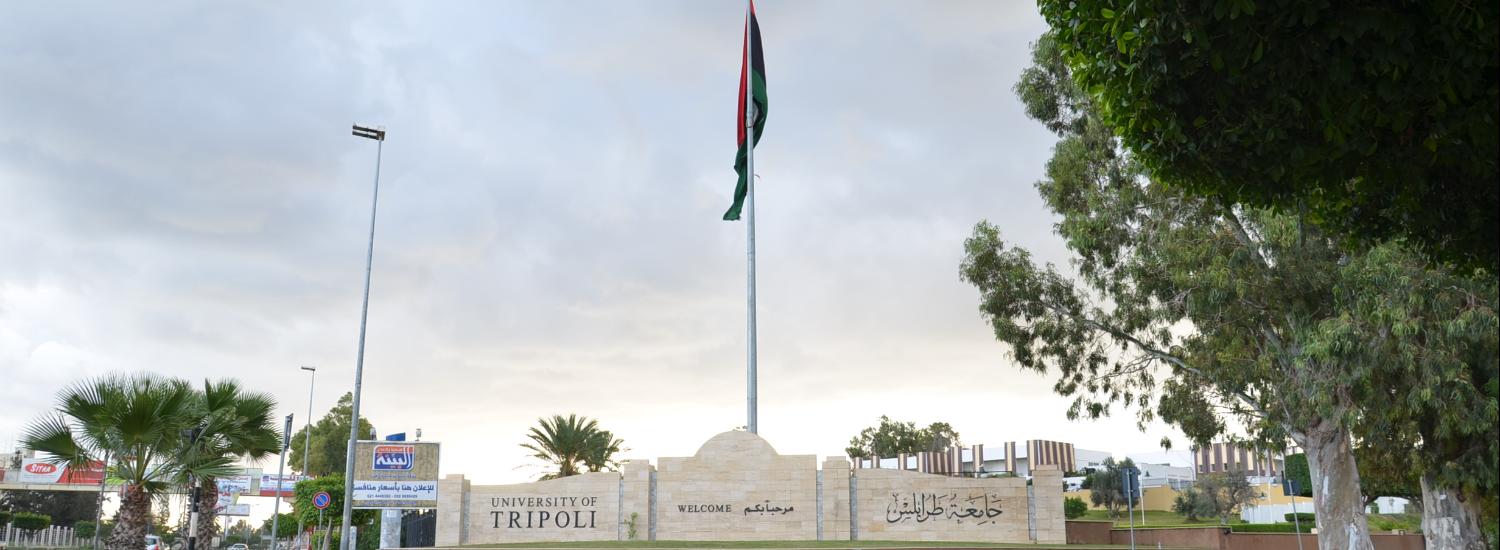
Faculty of Science

More ...

About Faculty of Science

Faculty of Science

The Faculty of Science is the core at the University of Tripoli, as it was the first that established in this prestigious university. It is also the first faculty of science in Libya. At the present, it includes ten scientific departments: Departments of Zoology, Mathematics, Physics, Chemistry, Botany, Geology, Computer Science and Statistics, Atmospheric science and geophysics. It currently works to create a new department of Archaeology in order to study the scientific and research side of the historical heritage of the Libyan people. Graduates of this college have worked in various governmental sectors, such as oil exploration, extraction and refining, chemical industries complexes in Abu Kamash and Ras Al-Anuf, as well as plastics companies in production and manufacturing, and in factories for soap, cleaning materials and others. They were also recruited by the education sector in different research and pedagogical areas.


The graduates of this faculty have led the scientific process for many years and still represent the first building block in all colleges of science, and some other colleges in all Libyan universities for the past five decades. The scope of work for graduates included Faculties of Medicine (in the field of basic sciences, biochemistry, anatomy, histology and microbiology), many departments in the Faculty of Agriculture, general engineering, chemical and geological engineering; in particular, medical technology and pharmacy, and the Faculty of Economics and Arts. The Faculty of Science provides teaching assistants to other faculties and universities in the Libyan state.


The Faculty of Science is the first to create graduate studies programs in Libya, despite the nature of graduate studies in basic sciences, which need capabilities other than competent professors. Teaching staff in this institution graduated from international universities in the West and the East (USA, UK, Australia, and other European countries). They graduated from universities that are well-known for their high academic standard.


Having obtained their first university degree or higher degrees of specialization from Libya or abroad, graduates of Faculty of Science worked for industrial and nuclear research centers, petroleum sector, marine life, biotechnology, plastics, and other specialized research centers.


The Faculty has also enriched the scientific research movement in the fields of basic sciences in the Libyan state through the issuance of refereed basic science journal.


Facts about Faculty of Science

We are proud of what we offer to the world and the community

170

Publications

267

Academic Staff

1831

Students

686

Graduates

Programs

Major

...

Details
Major

...

Details
Major

...

Details

Who works at the Faculty of Science

Faculty of Science has more than 267 academic staff members

staff photo

Dr. Khaled Mohamed Ramadan Etmimi

عضو هيئة التدريس بقسم الفيزياء/كلية العلوم بدرجة أستاذ مشارك.

Publications

Some of publications in Faculty of Science

المحاكاة لتقنية الصدى المغزلي في بعدين بتقنية التصوير الطبي للرنين المغناطيسي

ندرس في هذا البحث إحدى طرق التصوير بالرنين المغناطيسي، وهي طريقة الصدى المغزلي في بعدين. يحتوي هذا البحث علي ستة فصول، ففي الفصل الأول تم إعطاء لمحة تاريخية عن تقنية (MRI) بوجه عام، وفي الفصلين الثاني والثالث تمت المعالجة للأسس (MRI) الفيزيائية والرياضية، وفي الفصل الرابع تمت دراسة طريقة الصدى المغزلي في بعدين، وقد تم في الفصل الخامس إستعراض الدراسة العملية لحساب الإشارة المتحصل عليها لبعض الأنسجة (Tissue) بجسم الإنسان. وهذه الأنسجة هي: سائل النخاع الشوكي(Cerebrospinal Fluid). المادة البيضاء(White Matter). المادة الرمادية(Gray Matter). الورم(Tumor). لقد تم دراسة التباين(Contrast) لهذه الطريقة بإستخدام برنامج الحاسب بيئة(Math CAD)، وإستخدمت تحويلات فورييه السريعة(Fourier TransForm) لتحويل الإشارة المتحصل عليها من دالة في الزمن إلي دالة في التردد والمجال المتدرج. وتعرض النتائج المتحصل عليها في الفصل السادس.
زهرة علي العربي أبو راص (2014)
Publisher's website

النمذجة الجيولوجية للبعد الثالث للمناطق الجافة باستخدام الاستشعار عن بعد بالتكامل مع الطرق الجاذبية

Abstract Murzuq Basin is located in south western of Libya. The theses represent a study of the concession (NC-174) area in Murzuq Basin. This theses consists of two major parts; the first part investigates the geophysical seismic interpretation of the concession (NC-174) area including the Elephant field area, and as a result the pressure of Elephant oil field (western part of (NC-174) concession) is not superior so that it needs to inject water interested in the oil structure. Therefore, the second part of theses provides better understanding of the aquifers study (Aquifers volume, extensions, isolation) within the concession (NC-174) area to be used for water injection of the oil reservoir of Elephant filed. The water injection method used in oil production is where water is injected back into the reservoir usually to increase pressure and thereby stimulate production. In this theses most visible horizons are interpreted by charisma software focused on the all aquifer water and (seal, reservoir, basement) formations, and the seismic interpretation includes all of the available 2-D and 3-D seismic data.The geophysical seismic interpretation method is used to cover the concession (NC-174) area, concentrates on the Elephant oil field using all the available seismic versions datasets. The main result of this thesis indicates that the Ordovician sandstone (Mamuniyat formation) is high-quality oil reservoir in the Elephant oil field and can be represent a saline aquifer outside the Elephant oil field structure (scorpion area_ southeast of Elephant oil structure ) either to the northern or southern hanging wall unless the main faults are not sealing. The Mamuniyat reservoirs sourced by hot shales of the Lower Silurian Tanezzuft Formation.
عادل المبروك التوجير (2009)
Publisher's website

Histone deacetylase 2 inhibitor valproic acid attenuates bisphenol A-induced liver pathology in male mice

Accumulating evidence indicates the role of endocrine disruptor bisphenol A (BPA) in many pathological conditions. Histone deacetylase (HDAC) inhibition has potential for the treatment of many diseases/abnormalities. Using a mouse BPA exposure model, this study investigated the hepatoprotective effects of the Food and Drug Administration–approved HDAC2 inhibitor valproic acid (VPA) against BPA-induced liver pathology. We randomly divided 30 adult male Swiss albino mice (8 weeks old; N = 6) into five groups: group 1, no treatment (sham control (SC)); group 2, only oral sterile corn oil (vehicle control (VC)); group 3, 4 mg/kg/day of oral BPA (single dose (BPA group)); group 4, 0.4% oral VPA (VPA group); and group 5, oral BPA + VPA (BPA + VPA group). At the age of 10 weeks, the mice were euthanized for biochemical and histological examinations. BPA promoted a significant decrease in the body weight (BW), an increase in the liver weight, and a significant increase in the levels of liver damage markers aspartate aminotransferase and alanine aminotransferase in the BPA group compared to SC, as well as pathological changes in liver tissue. We also found an increase in the rate of apoptosis among hepatocytes. In addition, BPA significantly increased the levels of oxidative stress indices, malondialdehyde, and protein carbonylation but decreased the levels of reduced glutathione (GSH) in the BPA group compared to SC. In contrast, treatment with the HDAC2 inhibitor VPA significantly attenuated liver pathology, oxidative stress, and apoptosis and also enhanced GSH levels in VPA group and BPA + VPA group. The HDAC2 inhibitor VPA protects mice against BPA-induced liver pathology, likely by inhibiting oxidative stress and enhancing the levels of antioxidant-reduced GSH.
Mohamed A. Al-Griw, Zaynab Osama Alshibani, Rabia Omar abdullah Alghazeer, Mohamed Elhensheri, Refaat. M. Tabagh, Areej A. Eskandrani, Wafa S. Alansari, Mahmoud M. Habibulla, Ghalia Shamlan(6-2022)
Publisher's website

Faculty of Science in photos

Faculty of Science Albums