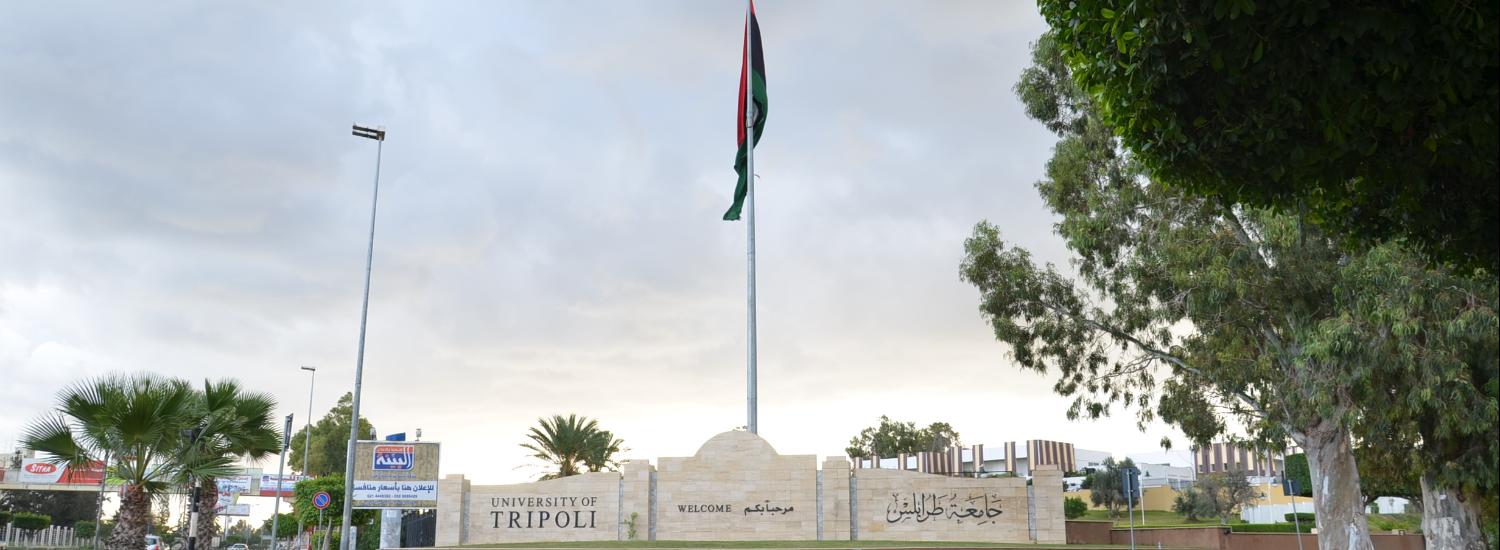
Department of Geophysics

More ...

About Department of Geophysics

Facts about Department of Geophysics

We are proud of what we offer to the world and the community

10

Publications

93

Students

64

Graduates

Programs

Major

...

Details

Publications

Some of publications in Department of Geophysics

النمذجة الجيولوجية للبعد الثالث للمناطق الجافة باستخدام الاستشعار عن بعد بالتكامل مع الطرق الجاذبية

Abstract Murzuq Basin is located in south western of Libya. The theses represent a study of the concession (NC-174) area in Murzuq Basin. This theses consists of two major parts; the first part investigates the geophysical seismic interpretation of the concession (NC-174) area including the Elephant field area, and as a result the pressure of Elephant oil field (western part of (NC-174) concession) is not superior so that it needs to inject water interested in the oil structure. Therefore, the second part of theses provides better understanding of the aquifers study (Aquifers volume, extensions, isolation) within the concession (NC-174) area to be used for water injection of the oil reservoir of Elephant filed. The water injection method used in oil production is where water is injected back into the reservoir usually to increase pressure and thereby stimulate production. In this theses most visible horizons are interpreted by charisma software focused on the all aquifer water and (seal, reservoir, basement) formations, and the seismic interpretation includes all of the available 2-D and 3-D seismic data.The geophysical seismic interpretation method is used to cover the concession (NC-174) area, concentrates on the Elephant oil field using all the available seismic versions datasets. The main result of this thesis indicates that the Ordovician sandstone (Mamuniyat formation) is high-quality oil reservoir in the Elephant oil field and can be represent a saline aquifer outside the Elephant oil field structure (scorpion area_ southeast of Elephant oil structure ) either to the northern or southern hanging wall unless the main faults are not sealing. The Mamuniyat reservoirs sourced by hot shales of the Lower Silurian Tanezzuft Formation.
عادل المبروك التوجير (2009)
Publisher's website

Static Corrections due to sand dunes in Concession 210 western Libya

هذه الدراسة تتركز على تحسين المعلومات بحل المشاكل الأستاتيكية الناتجة عن الكثبان الرملية في الامتياز (NC210) الذي يقع في حوض مرزق في الجنوب الغربي من ليبيا. وقد ثم اختيار عدد اثنين من الخطوط السيزمية وهما الخط (NC210-05-207) والخط (NC210-05-200) لإجراء هذه الدراسة. تم استخدم طريقتين لحساب التصحيحات الأستاتيكية وتم عرض النتائج. وبلغ طول هذين الخطين )26.5) كيلو متر وتم معالجتهما في شركة شمال أفريقيا للاستكشاف الجيوفيزيائ (NAGECO) باستخدام برنامج (ProMAX software, 2003) وكذلك برنامج (GeoTomo software).تم تطبيق معلومات الإنكسار السيزمي بطريقة (Delay Time Method) وكذلك طريقة حفر الآبار Uphole Method)) في هذه الحسابات. وأخيراً تم عرض أمثلة للمقاطع السيزمية باستخدام هاتين الطريقتين ومناقشة النتائج المتحصل عليها. Abstract This study deals with static problems on seismic reflection profiles over sand dunes in concession NC210 in Murzuq Basin southwestern Libya. Two methods of computing field statics have been implemented and the results are presented. Two seismic lines of 26.5 km total length that crossed over sand dunes were processed in North Africa Geophysical Exploration Company (NAGEC) using proMAX software package for seismic data processing and GeoTomo software for inversion static correction softwares for each set of field statics. The refraction field statics are estimated by picking the first break from seismic reflection records using delay time method. The second method of field statics that has been used in this study is the uphole method or conventional method. Examples of brute stack sections of both seismic lines have been presented with two different field statics.range from fair (10%-20%) and lower Nubian (6%-15%). The permeability values range from (2.40 md) to (91.1md), water saturation varies across the reservoir due to the location with respect to the boundaries of the field, averaging 33%. Nubian formation the cement is quartz overgrowth and pore filling cements including anhydrite, chlorite and clays (kaolinite, chlorite and illite/smectite). The oil contact (owc) 3v-59 is defined to be at sub sea depth of 110110 ft. and 97-II NC (OWC) was observed in the reservoir section. The Net Pay is 235 ft at 6% porosity cut off for Q2well, and Q1well the net pay123ft, at 6% porosity, 3v3 the Net pay is 273.5 ft, MOS is 5.64 ft, and residual oil column heigh 7.133 ft, and 3v4 well the net pay equal 324.0 ft, at 6% porosity, Net pay is 273.5 ft, MOS is 3.05 ft, and residual oil column high 2.701ft, and oil saturation 54.66%, Difference in formation water salinity between wells where 3v-59E has salinity of 160,000ppm and OO82 is 215,000 pm. This difference in salinity affects the formation resistivity actor, consequently, the cementation factor because the formation factor depends on many parameters such as porosity, pore size and structure; salinity of connate water and irreducible water saturation.
عبد المجيد عمر أبو محلولة (2013)
Publisher's website

The Role of Remote Sensing in Supporting Urban Planning in Libya a Case Study of Tripoli Area

Abstract Libyan cities have experienced a period of rapid urban expansion in the past decades. Urban growth as an example has been the focus of urban researches for a long time. Due to the complexity of the urban growth process, it’s very difficult to model urban growth using traditional urban models. Recently, urban researches are keen on a new technology, Remote Sensing. Remote Sensing technique was applied in many aspects of life, due to ability of covering and representing the real world around us. In urban research, field researches set up many applications to simulate the urban phenomena such as sprawl process, landuse change trends, landcover...etc. Remote sensing technology helps to extract and organize the data about such phenomenon. In addition to understand their spatial relationships, and provides a powerful means to planners and decision makers for analyzing and information about a place or a phenomenon. This will have great impact on the quality of the decision-making. The study uses Spot 5 images, topographic maps which derived from aerial photographs for the year 1980. The remote sensing image interpretation and change detection to review the urban expansion for the study area in (1980 and 2009).Spot satellite image of 2009 and Landuse maps1980 will be used to derive information on urban land use in the study area. The visual interpretation is used to extract landuse. The mutual use of Remote Sensing (RS) and Geographic Information System (GIS) describes the overall physics changes of the study area. This effort can be considered as an application case in this field (RS-based town planning information system), where this thesis show how that system can be useful of using this technology and supporting the sector by developing a model that can support the process of planning and maintain what remained of the agricultural lands to prevent them from encroachment by the urban growth.
حسين علي أحمد زيدان (2010)
Publisher's website