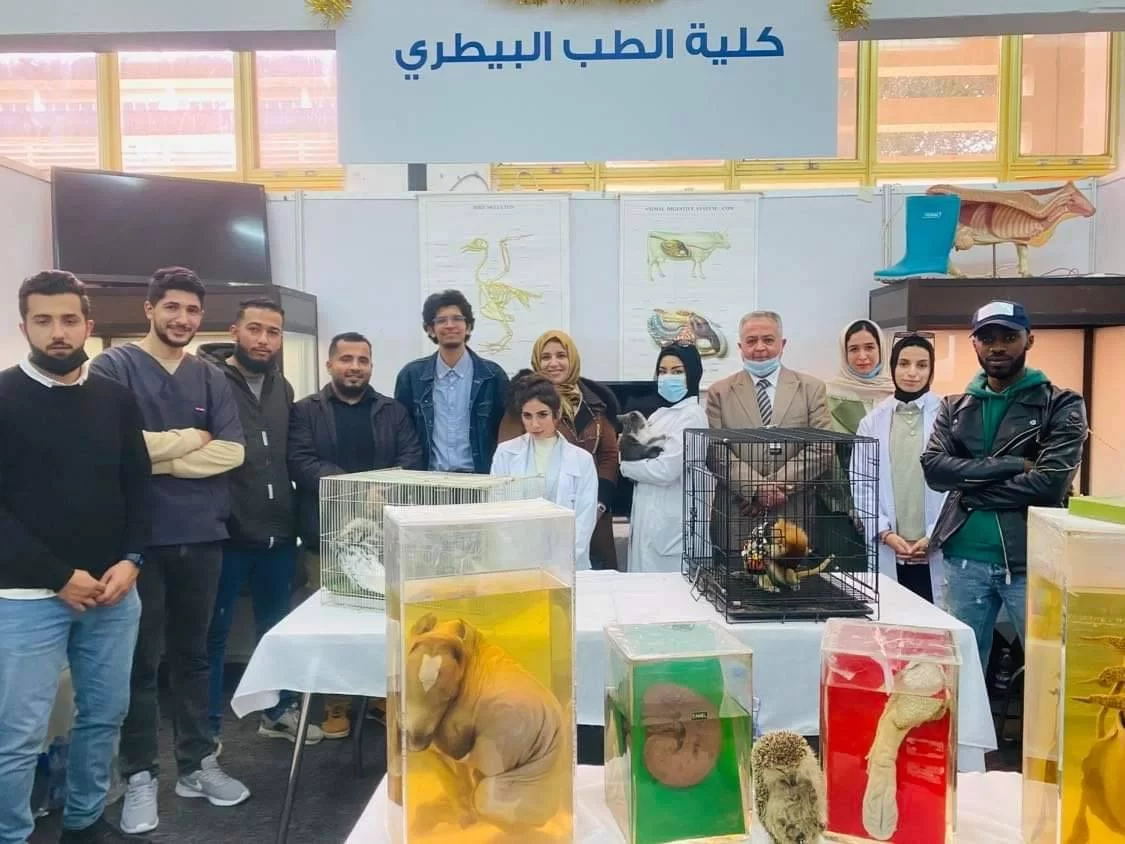



كلية الطب البيطري

المزيد ...

حول كلية الطب البيطري

تأسست كلية الطب البيطري عام 1975م كأول كلية للطب البيطري في ليبيا. تعد الكلية من قلاع العلم و المعرفة الهامة بجامعة طرابلس ومؤسسة علمية تلبي إحتياجات المجتمع من الأطباء البيطريين وتساهم في دعم الإقتصاد الوطني من خلال العناية بصحة الحيوان وزيادة الإنتاج الحيواني والمحافظة على صحة الإنسان وحماية البيئة.

حقائق حول كلية الطب البيطري

نفتخر بما نقدمه للمجتمع والعالم

194

المنشورات العلمية

86

هيئة التدريس

245

الطلبة

23

الخريجون

البرامج الدراسية

ماجستير أمراض الدواجن
تخصص أمراض الدواجن

يُنفذ هذا البرنامج من خلال دراسة مقررات دراسية، بحيث لا يقل عدد وحداتها عن (24) وحدة دراسية، وأن لا تزيد عن (30) وحدة دراسية على مدى 3 فصول، بالإضافة إلى إنجاز رسالة بحثية...

التفاصيل

ماجستير أمراض الاسماك
تخصص أمراض الاسماك

يُنفذ هذا البرنامج من خلال دراسة مقررات دراسية، بحيث لا يقل عدد وحداتها عن (24) وحدة دراسية، وأن لا تزيد عن (30) وحدة دراسية على مدى 3 فصول، بالإضافة إلى إنجاز رسالة بحثية...

التفاصيل


من يعمل بـكلية الطب البيطري

يوجد بـكلية الطب البيطري أكثر من 86 عضو هيئة تدريس

staff photo

أ.د. لطفي موسى ساسي بن علي

ا.د. لطفي بن علي هو احد اعضاء هيئة التدريس بقسم الجراحة والتناسليات بكلية الطب البيطري.انخرط بالسلك التدريسي بجامعة طرابلس كمعيد مند (1988) والان يشغل درحة استاد منذ 2015 وله العديد من المنشورات العلمية في مجال تخصصه

منشورات مختارة

بعض المنشورات التي تم نشرها في كلية الطب البيطري

Beckwith–Wiedemann syndrome caused by maternally inherited mutation of an OCT-binding motif in the IGF2/H19-imprinting control region, ICR1.

The imprinted expression of the IGF2 and H19 genes is controlled by the imprinting control region 1 (ICR1) located at chromosome 11p15.5. DNA methylation defects involving ICR1 result in two growth disorders with opposite phenotypes: an overgrowth disorder, the Beckwith-Wiedemann syndrome (maternal ICR1 hypermethylation in 10% of BWS cases) and a growth retardation disorder, the Silver-Russell syndrome (paternal ICR1 loss of methylation in 60% of SRS cases). In familial BWS, hypermethylation of ICR1 has been found in association with microdeletion of repetitive DNA motifs within ICR1 that bind the zinc finger protein CTCF; but more recently, ICR1 point mutations were described in BWS pedigrees. We present a case report of two brothers with BWS and prolonged post-pubertal growth resulting in very large stature. A maternally inherited point mutation was identified in ICR1 in both brothers, which altered binding of OCT transcription factors. The same mutation was present on the paternally inherited allele of their unaffected mother. This is a second report of a point mutation causing ICR1 hypermethylation by altering an OCT-binding motif. The atypical growth phenotype of the brothers may be connected to the unusual underlying cause of their BWS. arabic 24 English 118
Rebecca L Poole, Donald J Leith, Louise E Docherty, Mansur Ennuri Moftah Shmela, Christine Gicquel,, Miranda Splitt, I Karen Temple, Deborah J G Mackay(2-2012)
Publisher's website

Sero-prevalence and epidemiology of peste des petits ruminants in Libya

We conducted a cross-sectional study during 2013 to quantify the serological prevalence of peste des petits ruminants (PPR) infection and to investigate host factors associated with PPR infection in small ruminants in Libya. A two-stage sampling design was carried out. A total number of 148 flocks owning at least 100 heads each were randomly selected. Sixteen to forty-eight samples were collected from each selected flock. A total number of 3,508 serum samples from unvaccinated animals were collected and analysed at IZSLER Brescia, Italy, by using competitive ELISA, IDvet innovative diagnostics (IDvet 310, France). The overall serological prevalence among SR was 33% (95% CI: 31.4–34.5). Significant differences between the prevalence in the geographical branches were observed. The lowest prevalence level was observed in Zawiyah branch (16.1%), whereas the highest value was obtained for the Sabha branch (56.8%). Considering the age, a serological prevalence of 24.7%, 31.5% and 42.1% was observed in SR
Ibrahim Eldaghayes(7-2017)
Publisher's website

Antimicrobial Sensitivity Patterns of Pseudomonas aeruginosa Isolates Obtained From Foot Ulcer Diabetes Patients in Tripoli, Libya.

Background: Pseudomonas aeruginosa is one of the most invasive organism that causes severe tissue damage in diabetic foot ulcers. A major problem in P. aeruginosa infection because of that it is commonly exhibits a high degree of resistance to antimicrobial agents .To improve appropriate antimicrobial therapy and reduce the incidence of antibiotics resistant bacteria, information on the antibiotic susceptibility to this bacterium is urgently needed. Therefore, the aim of this study was to isolate and determinate the antimicrobial susceptibility of the P. aeruginosa in diabetic foot ulcers patients. Methods: This study was carried out over the period between June 2014 to April 2015 at Tripoli Medical Center. A total of 120 bacterial isolates were cultured onto bacteriological media such as nutrient agar, MacConkey agar and blood agar. Identification of retrieved bacterial isolates was done using standard diagnostic microbiological laboratory methods and antibiogram was determined by VITEK ® 2 compact automated system. Results: Twenty one strains of P. aeruginosa from 120 diabetic foot ulcers were detected. P. aeruginosa isolates exhibited multidrug resistance to Ampicillin, Augmenting, Cefuroxime, Cefoxitin, Cefazolin, Ceftriaxone, Trimethoprim/sulfamethzole, Piperacillin. However, all isolates of P. aeruginosa were 100 % sensitive to Imipenem. Conclusion: P. aeruginosa infections of diabetic foot ulcers patients have multi-drug resistant. Imipenem is the empirical antibiotic of the choice. Key words: Pseudomonas aeruginosa, diabetic foot ulcer, antibiotics resistance arabic 17 English 114
Abdulkareem Elbaz, Abdulkareem Elbaz, Abdulgader Dhawi, Asma K. Elramalli, Ibrahim A. Algondi, , , Mustafa Saieh(12-2018)
Publisher's website

قناة كلية الطب البيطري

بعض الفيديوات التي تعرض مناشط كلية الطب البيطري

اطلع علي المزيد