
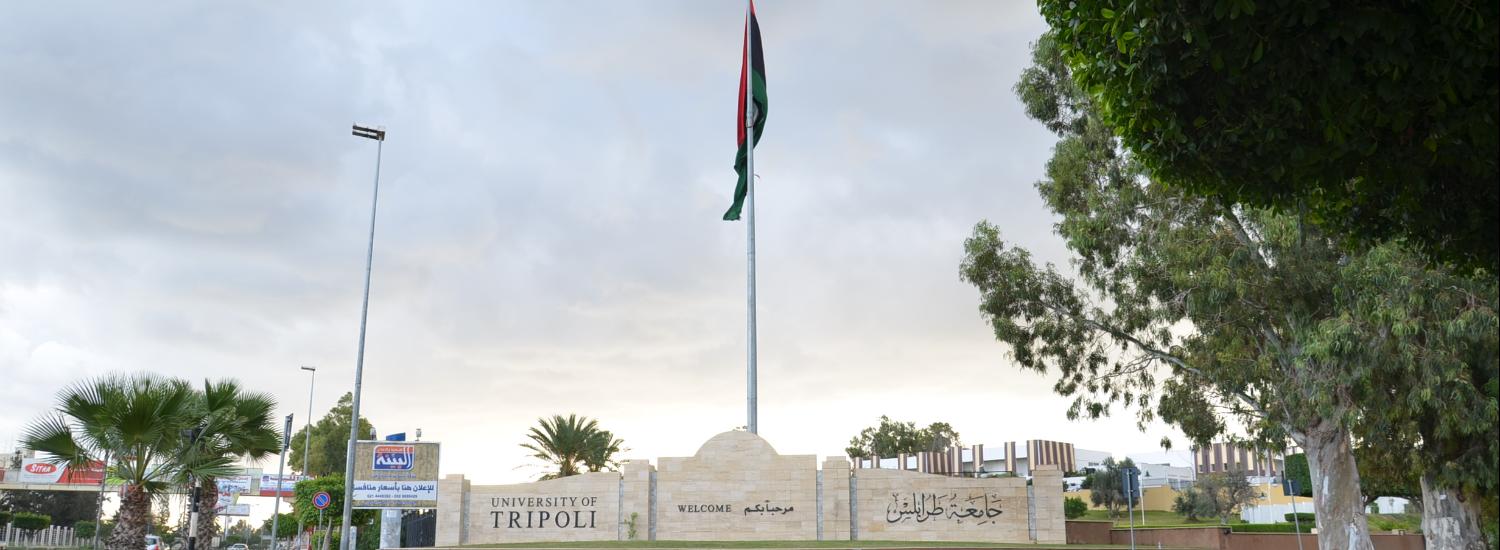
قسم الهندسة الكهربائية والالكترونية

المزيد ...

حول قسم الهندسة الكهربائية والالكترونية

قسم الهندسة الكهربائية والإلكترثونية من أقدم وأهم أقسام كلية الهندسة بجامعة طرابلس حيث تم إنشاؤه مع إنشاء الكلية في عام 1961 م.  وقد شهد القسم خلال السنوات الأخيرة تطورات ملحوظة تمثلت في

تحديث محتويات المقررات وشملت هذه التطورات أيضا تحديثا في تجهيزات معامل القسم. ويتولى تسيير البرنامج العلمي والبحثي  بالقسم أكثر من 40 عضو هيئة تدريس في  تخصصات مختلفة. القسم يحوي عدد

من التخصصات الحيوية والمتطورة مثل الاتصالات والإلكترونيات والكهرومغناطيسيات والقوى والآلات الكهربائية والتحكم الآلي  والأتمتة والحاسوب.

حقائق حول قسم الهندسة الكهربائية والالكترونية

نفتخر بما نقدمه للمجتمع والعالم

48

المنشورات العلمية

42

هيئة التدريس

1292

الطلبة

0

الخريجون

البرامج الدراسية

بكالوريوس في هندسة الاتصالات والالكترونيات
تخصص هندسة الاتصالات والالكترونيات

...

التفاصيل
بكالوريوس في هندسة التحكم و الأتمتة
تخصص هندسة التحكم و الأتمتة

...

التفاصيل

من يعمل بـقسم الهندسة الكهربائية والالكترونية

يوجد بـقسم الهندسة الكهربائية والالكترونية أكثر من 42 عضو هيئة تدريس

staff photo

أ. تيسير يوسف سالم الغنيمي

Taissir Y. Elganimi was born in Tripoli, Libya, in 1988. He received his B.Sc. degree in Electronics and Communication Engineering from Department of Electrical and Electronic Engineering at University of Tripoli, Libya, in 2010, and his MSc degree in Wireless Communications (with distinction) from University of Southampton, UK, in 2015. He is currently working as a lecturer in Department of Electrical and Electronic Engineering at University of Tripoli, Libya. Taissir serves as a technical reviewer for several IEEE transaction journals, and has been a member of Technical Program Committees (TPC) for several IEEE conferences such as ICC, WCNC, GLOBECOM, etc. He is also an IEEE senior member. His research interests mainly include multi-functional MIMO, space modulation techniques, multidimensional index modulation, optical communications, millimeter-wave massive MIMO communications, and reconfigurable intelligent surface-assisted MIMO systems for 6G communications

منشورات مختارة

بعض المنشورات التي تم نشرها في قسم الهندسة الكهربائية والالكترونية

An Interactive Program for Three Phase Overhead Transmission Line Design Using MATLAB

تقدم هذه الأطروحة برنامج حاسوبي تفاعلي لتصميم خطوط النقل الكهربائي ثلاثية الأطوار باستخدام MATLAB. يمكن استخدام هذا البرنامج كوسيلة تعليمية داخل وخارج الفصل الدراسي لشرح أساسيات و ضواهر خطوط النقل الكهربائي.تتناول اغلب الكتب المرجعية المتاحة حاليا لمحتويات خطوط النقل التصميم الكهربائي فقط ولهذا السبب فان اغلب طلاب هندسة القوى الكهربائية يتخرجون من الجامعة وبدون دراية كافية عن الجزء المتعلق بالتصميم الميكانيكي والمتمثل في حسابات ارتخاء الخط والشد على الأبراج وزيادة وزن الموصلات نتيجة لتجمع الثلوج أو زيادة سرعة الرياح وتغير كل من ذلك مع درجات حرارة الجو. كما أن هذا البرنامج مزود ببعض البرامج الإضافية الأخرى والمتمثلة في حسابات قيم سعات ومتحاثات خطوط النقل أخدا في الاعتبار السلك الأرضي. كما أن هذا البرنامج يمكن استخدامه لمعرفة المعاوقات والسعات التسلسلية ( الصفرية والموجبة).وقد تم تزويد هدا البرنامج بقاعدة بيانات تحتوى على مواصفات شاملة للعديد من الموصلات المستخدمة في خطوط النقل الكهربائي.كما أن هذا البرنامج يمكن استخدامه لحسابات شدة المجال الكهربائي حول الموصلات وبالقرب من الأرض. Abstract This thesis presents an interactive computer program for three phase overhead transmission line design using MATALB. This program can be used as a self learning tool to understand the course material offered in class and to enhance students understanding to the three phase transmission line subject. This first course is normally given as a core course to all electrical engineering students. Most of the existing text books in power system analysis nowadays cover the Electrical line design only and describe the line performance very efficiently with very few power text books which treat the mechanical line design part. Therefore electrical engineering students with power engineering major are often graduated from school without having sufficient background concerning the mechanical line design features such as; line sag, the mechanical tension at the tower and the conductor sag due to temperature variations or line loading, conductor thermal limit ….etc. The program is also equipped with an additional feature to compute the line sequence impedances and the line sequence capacitances. Other line features are also provided in this package such as ; thermal limit line calculation, line voltage stability phenomena and the electrical field calculation due to transmission line. Therefore using this program the students will then be able to compute the line sequence parameters for both the single circuit as well as the double circuit tower configuration, with and without ground wire. The package has been also provided with a built in data base library to most of the available power line conductors. Therefore power engineering students will then be able to understand the transmission line course contents in more depth and to use the other supporting program modules as a self learning tool for line design and line modeling performance.
.سالم مسعود الكردي (2010)
Publisher's website

A product form queuing model for a 3G cellular mobile network

In this paper, we present an analytical traffic model for the Universal Mobile Telecommunication Systems (UMTS). In 3G networks we have dynamic capacity that depends on the interference levels in the covered area and the number of active users. This implies that the distance of the mobile user from the base station is also an important factor because of the signal fading. The first part of this paper is an algorithm written in c++ programming language that distributes users in different zones assuming that the cell area is virtually divided into Z zones depending on the number of users. The last part of this paper we build a mathematical model of a 3G cell using the above assumption , and to prove, that the product form holds in the case of two cells with uniform and non uniform traffic. By this result more complicated networks can be analyzed, to calculate the performance measures of the network.
WAEL S. ABUGHRES, MIKE E. WOODWARD(6-2006)
Publisher's website

Voice Quality Enhancement in VoIP Networks byReducing Packets Los

Abstract Voice over IP (VoIP) uses the Internet Protocol (IP) to transmit voice as packets over an IP network, like the Internet, Intranets and Local Area Networks (LAN). Here the voice signal is digitized, compressed and converted to IP packets and then transmitted over the IP network. However, at the receiving end, some packets may be missed in its way due to network congestion. This packets loss degrades the quality of speech at the receiving end of a voice transmission system in the IP network. Since the voice transmission is a real time process, the receiver cannot request for retransmission of the missing packets. High speed networks provide real time variable bit rate service with packet loss requirements. The burstiness of the correlated traffic makes dynamic buffer management highly desirable to satisfy the Quality of Service (QoS) requirements. This thesis presents an algorithm to improve and optimize the Adaptive Buffer Allocation Scheme to deal with input traffic based on loss of consecutive packets in data streams and buffer occupancy levels. Buffer is designed to allow the input traffic to be partitioned into different priority classes, and based on the input traffic behavior it controls the threshold dynamically. This scheme allows input packets to enter into buffer if its occupancy level is less than the threshold value for priority of that packet. The threshold is dynamically varied in runtime based on packet loss behavior. The performance evaluation is carried out using simulation and is carried out for two and multiple priority classes of the input traffic "real time and non real time classes". The simulation results show that the Modified Adaptive Partial Buffer Sharing (ADPBS) has better performance than Adaptive Partial Buffer Sharing under the same traffic conditions.
اسماء احمد الكيش (2010)
Publisher's website